





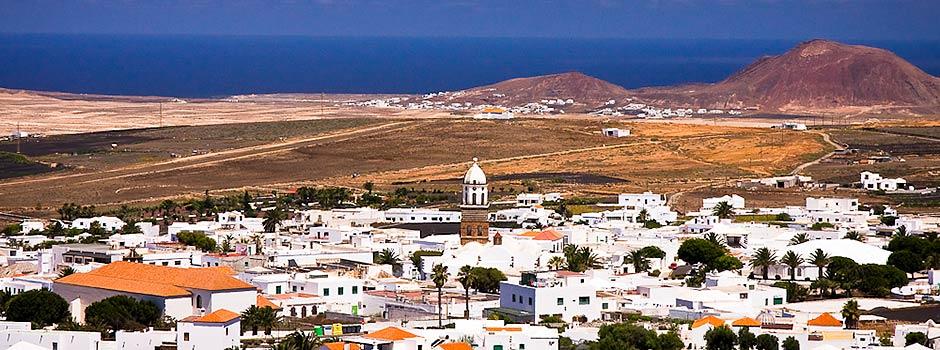
Alive with history, culture, architecture and charm, the town of Teguise in the northern-central area of Lanzarote is full of great stories from its rich and vibrant past.
Travel through the passages of time in this attractive town, which until 1852 was the island’s capital. Its high ground and central position were advantageous because it was regularly attacked by pirates. These raids reached a violent climax in the early days of colonisation when thousands of bandits tried to overrun the town. The small street of Callejón de La Sangre (Alley of the Blood) is a memorial to the bloody events of those bygone days.
With its narrow, well-kept cobbled streets, airy squares, an imposing parish church, two historic convents and some beautifully restored domestic buildings, this small, tranquil town has kept much of its colonial charm, splendour and dignity.
The white parish church Iglesia Parroquial de Nuestra Señora de Guadalupe, also known as Iglesia de San Miguel, dominates the town centre, occupied by the Plaza de la Constitución – or Plaza de San Miguel as residents call it. Guarded by two impressive statues of lions, this pretty square originally dates back to the 15th Century, although it has been restored many times over the years.
Every Sunday morning the town comes alive, when one of the island’s largest markets takes place in the square in front of the church, the surrounding alleyways and the park. People come from all over the island to view the merchandise of the many stalls selling all kinds of things: craft items, ceramics, jewellery, paintings, antiques, trinkets and souvenirs.
There are often folklore shows in the square, which usually attract many spectators who enjoy the performances while sampling the local specialities offered at the stalls and in the surrounding restaurants. Besides this colourful bazaar-like Sunday market, Teguise also boasts numerous shops and galleries, offering a rich variety of shopping options.


Opposite the church stands the Palacio Spínola, a beautiful mid-18th Century Renaissance mansion, formerly home to various noble families. During the 1980s it was bought by the town council, restored under César Manrique’s supervision and converted into a museum. It is now an official residence of the Government of the Canary Islands and occasionally it also houses art exhibitions. All rooms, including the courtyard, are open to the public and can be visited from Monday to Friday between 09:00 and 16:00, Sundays and holidays between 09:30 and 15:00. Closed on Saturdays.
There are also two important convents in Teguise, the older of which is the Convento de San Francisco, located at the south-eastern end of the town. Built by Franciscan missionaries in the late 16th Century, this beautiful building is filled with interesting artworks and a museum that is open Monday to Friday from 09:00 to 15:00, and on Saturdays and Sundays from 09:30 to 14:00. Closed on Tuesdays.
At the south-western end of the town lies the Convent of Santo Domingo, which is believed to have been founded in 1726. Today, the abbey serves as a modern art gallery – the Centro de Arte – with exhibitions of works by internationally renowned artists. It is open Monday to Friday from 10:00 to 15:00, and Sundays from 10:00 to 14:00. Closed on Saturdays.
Teguise also boasts a number of charming, nicely renovated domestic buildings from the 17th and 18th Centuries, with traditional architectural features like whitewashed walls, corners of black or red volcanic stone, wooden doors and windows and the odd wooden balcony.
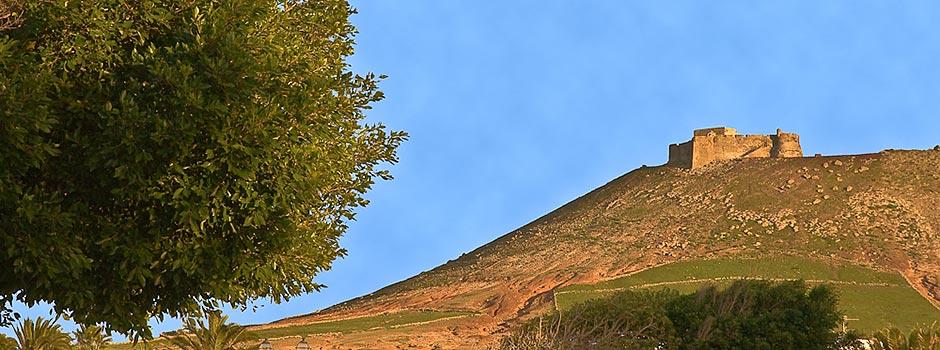
Towering over the town in the east is the bulky two-towered Castillo de Santa Bárbara, perched on the rim of the extinct volcano Guanapay.
Originally built as a watchtower to observe both the north and the south coast, it was used to scan the seas for pillaging pirates.
Since 1991 the castle houses the Museo del Emigrante Canario (Emigrant Museum), which tells of inspiring, sometimes also very tragic, stories of Canary Islanders, who – in search of a better life and to escape death of hunger on their native islands – emigrated in masses to South and Central America.
The museum is open from Monday to Sunday between 10:00 and 17:00, Saturdays and Sundays from 10:00 to 16:00 (Winter), and from Monday to Sunday between 10:00 and 16:00 (Summer).
There is a nominal entrance fee.
