




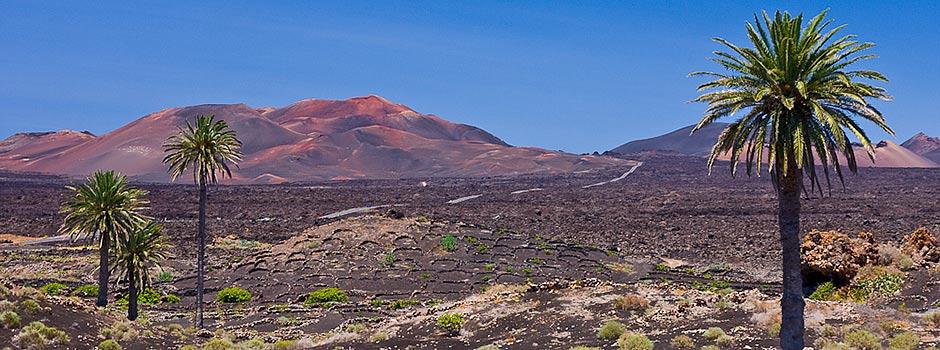
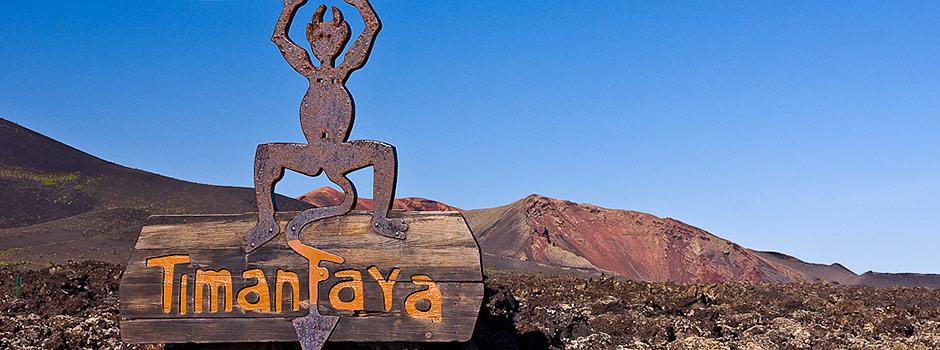
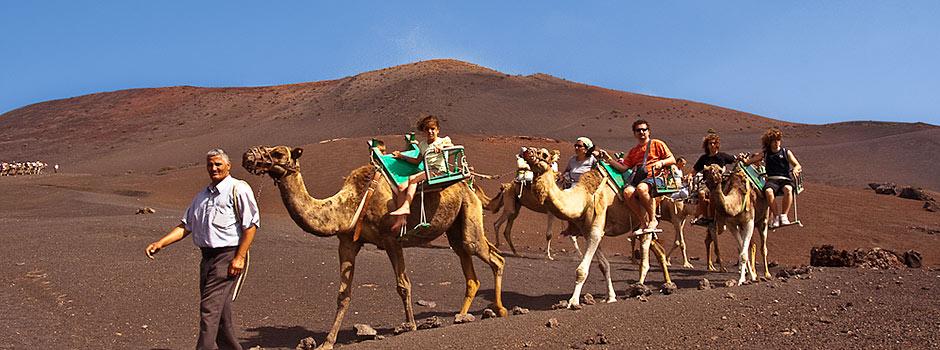
The boundary to the Parque Nacional de Timanfaya is marked by a sign carrying the mischievous El Diablo (The devil) logo – designed by César Manrique. Shortly afterwards, you will pass the camel park Echadero de los Camellos, from where a 20-minute ride on a dromedary will take you around the outer reaches of the Timanfaya National Park, should you wish to experience this interesting way of travelling! Near the camel station is the small geological museum Museo de Rocas, which exhibits rock samples from the park.
Named after a village that was one of the eleven settlements that were buried by lava and ash during the volcanic eruptions in the early 1700s, the Parque Nacional de Timanfaya was declared a protected National Park in 1974.
The grandiose, multicoloured volcanic landscape enclosing the Montañas del Fuego (Fire Mountains) stretches around 20 square miles (51 square kilometres) – just north of Yaiza to Masdache and westwards, where it covers a considerable part of the northwest coast. It is undoubtedly the highlight of Lanzarote’s landscapes, though almost completely devoid of any bird, animal or plant life.
History tells us of the dramatic volcanic eruptions in this area. During six years in the 18th Century, more than thirty volcanoes violently exploded, spilling fire, smoke and huge masses of magma onto the surrounding landscape, burying entire villages. Fortunately, people had already deserted their homes in time so that despite this natural catastrophe, there were no casualties. These eruptions transformed almost a quarter of the island into a sea of solidified lava, multicoloured volcanic rocks and copper-coloured sand, with wide areas covered with thick layers of lapilli (coarse ash). These materials formed the malpaís (badlands), and more than 250 years after these eruptions, there is still hardly any vegetation here. For the time being, the area is quite safe, though underneath the surface it is still bubbling and an odour of sulphur hangs in the air.


The Parque Nacional de Timanfaya can be visited but only on a coach tour or guided walks; free roaming around the park is not allowed. There is an entrance fee to be paid at a barrier a short distance along the road after the camel park.
The tour takes you for about 40 minutes on the 10 km (6.2 miles) long Ruta de los Volcanes, through the awesome heart of this surprisingly colourful landscape. On this extraordinary and unforgettable journey, you will enjoy awe-inspiring views over volcanic cones, look down into craters, see dunes of picón or lapilli and have a glance into lava tubes.
There are stops on this tour, but visitors are not allowed to get off the bus and you will have to take your much-desired pictures through the windows. You will also see the Islote de Hilario, a black volcano – which at 1,673 ft (510 metres) is the tallest of all the Fire Mountains – dominating the view. This amazing lunar landscape is a must see for any Lanzarote visitor. Please remember to wear suitable shoes and clothing, as the weather can be a little cooler here.
As part of your volcano experience, be sure to enjoy the El Diablo Restaurant with its interesting barbeque that uses geothermal heat and a cast iron grill placed over a hole in the ground – another ingenious César Manrique idea. Staff members also give impressive demonstrations which show the intense heat of the earth just below the surface... watch out for the flames!
The Parque Nacional de Timanfaya can be visited daily between 09.00 and 17.00 hrs and is open for two hours longer during the summer season (July 15th to September 15th).
There is a reasonably priced entrance fee.
